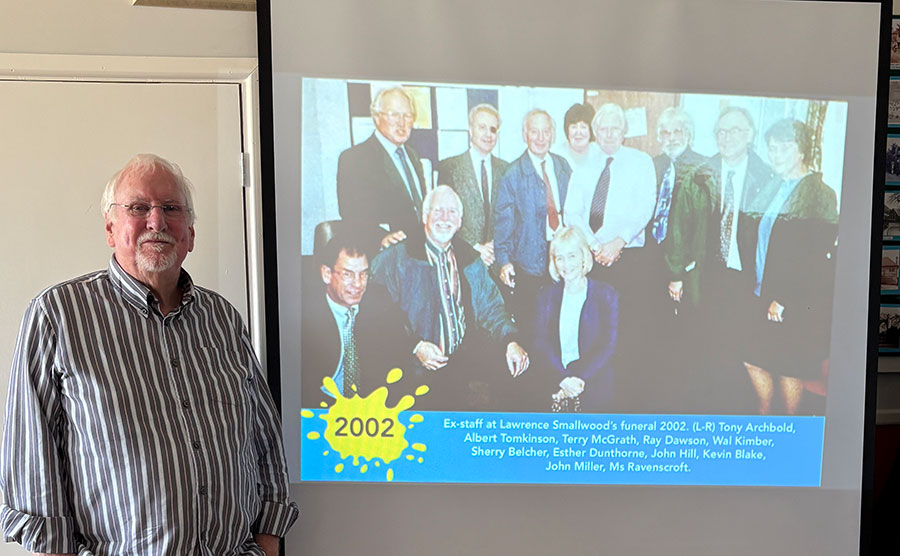
Our guest speaker today was Terry McGrath, who gave a brilliant talk about his days as an Art & Design Teacher at Greay Wyrley High School, titled – “It wor may Ser, arr day do it!”. There were alot of members remembering names of old teachers as Terry McGraph pointed them out on the staff photos from our archives.
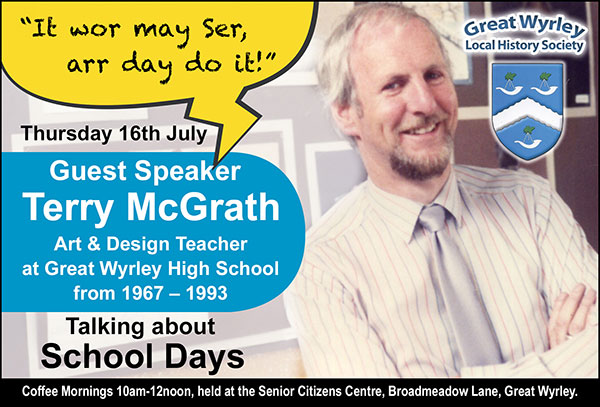
In 1967 aged 25, Terry was employed as sole art teacher at the school, replacing David Hammond. Coming from 4 years of teaching at a Brum inner-city school it came as a surprise how relaxed Wyrley was. The approximately 400 kids had a more rural and less aggressive attitude to life. Headmaster Wilf Davies seldom came out of his office and generally left the staff to our own devices in the classrooms. The small staff room on the top floor of the 1930s building reeked of tobacco smoke and sported a well-used dartboard at one end. A Horsa prefab classroom, known by everyone as the cowshed, stood alone in the back playground heated by a central unguarded coke stove which gave off choking fumes. It was stoked by a volunteer pupil.
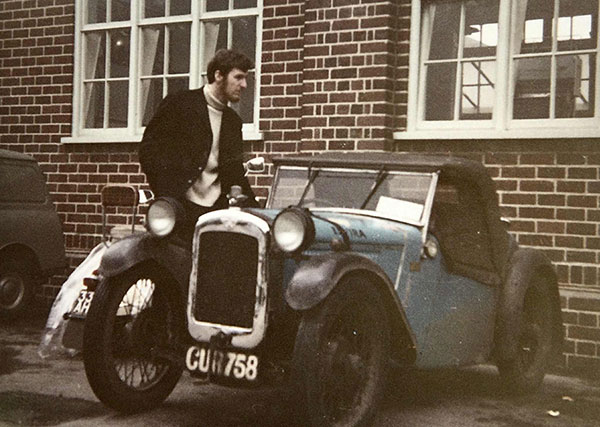
Various cheap Morris Travellers, VW Beetles and 1930s Austin 7s were Terry’s transport on the long journey from Birmingham each day, all rusty and in dire need of attention. Ray and John Dicken’s garage at the top of Cheslyn Hay welded the rotting metal together on a regular basis to keep Terry mobile. The school day finished at 3.40pm and in the rush to the school gates, teachers were sometimes out before the pupils! Other than termly reports, official paperwork was almost non-existent. No sixth form or A-Levels to worry about. Teaching was demanding but creative and good. Within a year Arthur Sweet took over the Headship. Things began to change. Tall, quiet, authoritarian and conservative he was a good headmaster for many years. Staff in 1967 that Terry remembers included Pete Probert (geography), Ken Handley (French), Margaret Howells (music), Frank Smith (maths) “Phoebe” Wilson (senior mistress). Joyce Hollins (needlework). Florrie Watson (remedial, an outdated word), Albert Tomkinson (geography).Frank Harvey (woodwork). Wally Kimber (metalwork). Derek Brooks was Deputy Head and Mrs Lunt the important Secretary.
Along on the top corridor was the sole Art room; (room 16), Terry’s domain. He managed to teach life drawing, painting, pottery complete with kiln, letterpress printing, scrap sculptures etc, all in that confined space with classes of 30-plus pupils, changing every hour and a half. Terry scrounged old picture frames and mounted pupil’s work to brighten the dreary corridors. Soon he started a pottery evening class for adults, and the school brass band. Having been a jazz trombonist since art school days, Terry managed to scrape together cornets, tenor horn, euphonium, tuba, sometimes gifted from the village folk, or parents, or my own instruments.
We rehearsed after school hours in the Art room where Terry tutored 13 to 15 years olds from scratch the rudiments of brass technique. Five or six of us struggled through simple marches and tunes from the Wrights & Rounds tutor books with the help of old Mr Sharp, an ex-Yorkshire miner who had been a cornetist and came in each week to help. They got competent enough to play hymns in morning assembly, but things reached it’s limit due to Terry’s inability to read sheet music (Terry said he still can’t). At this point Terry handed over the task to newly appointed Laurie Smallwood in the music department. Laurie was a trained cellist so Terry taught him how to handle a brass instrument, the cornet. The GW Brass Band has gone on from 1968 to do great things he hear…
Another after-school activity Terry initiated was foil fencing for older boys and girls. He ordered equipment, set out a piste in the hall and they had many enjoyable energetic after-school classes. Soon work began on the new extensions and in the 1970s Terry ended up with a huge, open-plan Art & Design Department with 2 extra Art staff; Diane Taylor, and Steve Astbury in Pottery. It was cold in winters, not helped by noisy ineffectual wall fan heaters and huge single glazed windows. Wood and Metalwork were next door, manned by Alex Meakin, Steve Clark. Malc Gentle, Pat Brindley, Wal Kimber, and dear Frank Harvey, who spent many years building an ancient church organ on the stage of the old hall.


It became a High School and pupil numbers increased to near a thousand and staff to around a hundred. Art was the first department to take 6th formers to A-Level GCE (Mr Sweet informed me). We exhibited our exam pupil’s impressive work each summer, filling the school hall with display boards, later going on to exhibit in both Cannock and Stafford Libraries and Shugborough Hall. Ex-pupils often remind Terry of the sin-bin, the tiny glass porch adjoining the Art rooms where I banished misbehaving and disruptive kids so to continue to get on with the lesson. (annoyingly they still waved and grimaced through the glass door!). “It wor may Ser, arr day do it!” It wasn’t me Sir, I didn’t do it… a common response Terry got from a kid who blatantly DID do whatever damage or piece of mischief Terry had just observed.
The Senior Master came across a surly 14-year-old sent into the corridor for bad behaviour from the Music Dept. by Mr Smallwood. “What’s up” said the Master?” “I hate music!” said the lad. “Oh dear! What else do you hate in school?” Long pause… “Liver.” Next day Mr Smallwood displayed a sign above the Music Dept. door –

Terry hated Sports Day, and marshalling the Sunday “30 mile” Cannock Chase Walk each year where he distinguished myself by sending pupils the wrong way…
After 30 continuous years of classroom teaching Terry felt burnt-out and drained of new ideas. The National Curriculum was being introduced. Impossible mountains of paperwork, forms, meetings, new initiatives, Health & Safety, extended reports for each pupil, was all too much for me (and many good teachers of my generation).
Terry bailed out of teaching in 1993 to become a self-employed jazz musician and recover his sanity. It is most satisfying to receive many messages of appreciation from ex-pupils over the years.